
How to Set a Realistic Budget for an Outdoor Living Project
You know you want to transform your backyard.
Maybe you're imagining a new paver patio and landscaping.
Or perhaps the vision is much larger: a pavilion, outdoor kitchen, fireplace, pool environment, retaining walls, landscape lighting and multiple spaces for entertaining.
Then comes one of the most important—and sometimes most difficult—questions:
How much should you budget for an outdoor living project?
There's no universal number.
Outdoor living projects can range dramatically in scope, complexity, materials and construction requirements.
That's why establishing a realistic budget isn't about finding an average price online and trying to make your property fit within it.
It's about understanding what you want to create, what your property requires and where your investment matters most.
Here's how Central Ohio homeowners can approach that conversation.
Start With the Complete Vision

Before determining what you're comfortable investing, think about what you ultimately want the backyard to become.
Don't begin by selecting individual products.
Start with the experience.
Ask yourself: How do we want to use this space?
Do you want somewhere to:
Cook outside?
Host friends and family?
Eat dinner?
Watch television?
Relax around a fire?
Spend time around a pool?
Give children room to play?
Enjoy more privacy?
Entertain after sunset?
Spend more time outside during spring and fall?
Those answers are more valuable at the beginning than deciding exactly which paver or grill you want.
They establish what the outdoor environment actually needs to accomplish.
Think Beyond Individual Features
It's easy to build an outdoor living wish list.

Patio.
Pavilion.
Outdoor kitchen.
Fireplace.
Pool.
Lighting.
Landscaping.
But a successful outdoor living project isn't simply a collection of features.
Those features need to work together.
For example, an outdoor kitchen affects the size and layout of the patio.
A pavilion affects foundations, shade, furniture placement and electrical requirements.
A pool influences grading, drainage, privacy and circulation.
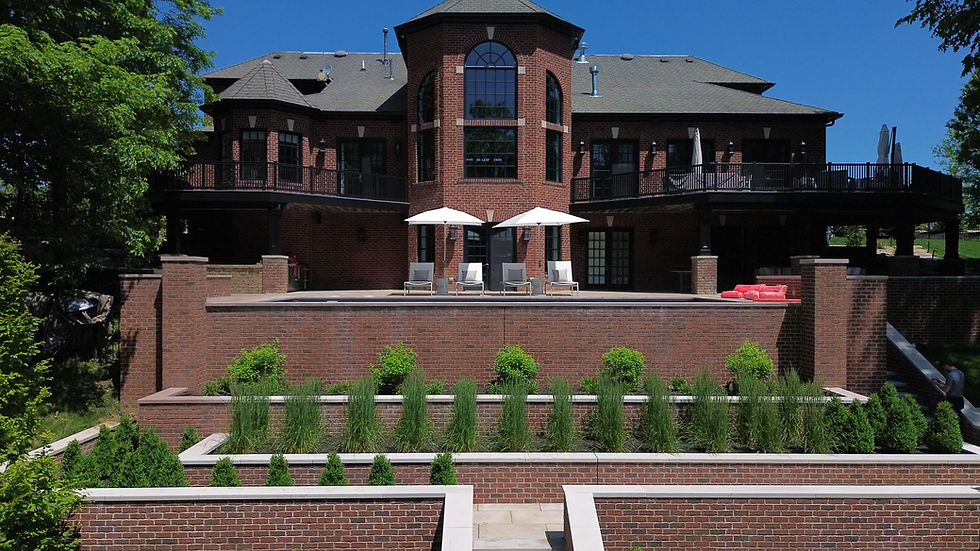
Retaining walls may determine whether usable outdoor space can be created at all.
That's why the budget should be considered across the complete environment, not feature by feature in isolation.
Understand What You're Actually Budgeting For
One of the biggest misconceptions about landscape construction is that most of the investment goes toward what you see when the project is finished.
That's only part of the story.
Your outdoor living investment may also include:
Landscape design
3D landscape design
Demolition
Excavation
Base preparation
Grading
Drainage
Retaining systems
Utilities
Foundations
Hardscape installation
Lighting
Masonry
Structures
Electrical work
Gas or plumbing
Planting
Project coordination
Some of the most important work may eventually be completely hidden.

The base beneath the patio.
The drainage behind a retaining wall.
The utilities beneath the outdoor kitchen.
The foundations supporting the pavilion.
Those components don't necessarily make the finished photograph more exciting.
But they're part of what makes the finished environment work.
Create Three Lists: Must Have, Would Like and Future
One of the simplest ways to establish a realistic outdoor living budget is to organize your ideas into three categories.
Must Have
These are the features that are essential to the project.
For example:
Replace a failing patio
Correct drainage problems
Create enough space for dining
Manage a steep slope
Add privacy
Improve access from the house
Create shade
These should receive priority during the design process.
Would Like
These are features that would significantly improve the outdoor experience but aren't necessarily essential.
Perhaps:
Outdoor kitchen
Fireplace
Pavilion
Premium paver selection
Expanded entertaining area
Additional landscape lighting
These features can be evaluated as the design develops.
Future
These are elements you may eventually want but don't necessarily need to build today.
Maybe that's:
Pool
Outdoor kitchen
Pavilion
Secondary patio
Fire feature
Expanded landscaping
Future doesn't mean forgotten.
If you're serious about adding these features eventually, they should still be considered during today's design.
Be Comfortable Discussing Budget With Your Landscape Designer
Homeowners sometimes hesitate to share a budget because they worry revealing a number will automatically cause the project to cost that amount.
But without understanding your investment expectations, a designer is working with incomplete information.
Imagine designing a complete backyard with:
Large paver patio
Pavilion
Outdoor kitchen
Fireplace
Retaining walls
Landscape lighting
Extensive planting
If the resulting project is significantly beyond what you're comfortable investing, everyone has spent time developing a vision that may need to be substantially reconsidered.
A productive budget conversation helps establish realistic parameters earlier.
The goal isn't: “How much can we spend?”
It's: “How should we allocate our investment to create the outdoor environment that matters most to us?”
Don't Ask Only, “What Does a Patio Cost?”
Individual cost questions are useful.
But they don't always tell you what the complete project will require.
A patio might also need:
Excavation
Drainage
Retaining walls
Steps
Walkways
Landscaping
Lighting
An outdoor kitchen may require:
Larger patio
Utilities
Cabinetry
Appliances
Countertops
Masonry
Pavilion
A pool environment may involve an entire backyard transformation.
Understanding individual feature costs is useful.
Understanding their relationships is more important.
What Factors Have the Biggest Impact on an Outdoor Living Budget?
Several factors can significantly influence the overall investment.
Project Scope
A patio and planting project requires a different investment than a complete backyard transformation.
Property Conditions
Slope, drainage, soil, existing hardscapes and accessibility can all affect construction.
Excavation
Removing existing materials and preparing the property can represent a significant portion of a project.
Grading and Retaining Walls
Properties with substantial elevation changes may require retaining walls, steps, drainage and additional site work.
Materials
Pavers, natural stone, masonry, countertops, cabinetry, structures and plant materials can vary considerably.
Structures
Pavilions, pergolas and gazebos introduce foundations, structural construction, roofing and potentially electrical work.
Utilities
Outdoor kitchens, lighting and other features may require gas, electric or plumbing.
Design Complexity
Multiple outdoor rooms, elevation changes, custom masonry and detailed material combinations generally require additional design and construction.
Don't Build Your Budget Around Cost Per Square Foot Alone
Homeowners naturally look for simple pricing formulas.
“How much does a patio cost per square foot?”
“How much does landscaping cost per square foot?”
Those numbers can sometimes provide context for individual components.
But they become less useful for complete outdoor living projects.
Consider two 800-square-foot patios.
Patio A
The property is relatively flat with easy access and a straightforward layout.
Patio B
The property has a significant slope requiring excavation, retaining walls, drainage, steps and limited-access construction.
Both patios have the same square footage.
They're not the same project.
That's why your property needs to be evaluated rather than priced exclusively from measurements.
Understand Where Quality Matters Most
When adjusting a project to align with a budget, the answer shouldn't automatically be:
Choose the cheapest version of everything.
Instead, identify where quality matters most.
There are areas where compromising construction can create much larger problems later.
For example:
Base preparation
Drainage
Retaining wall construction
Structural foundations
Proper grading
Those aren't necessarily the places to cut corners.
Instead, the design process may uncover opportunities to adjust:
Project size
Material selections
Appliance packages
Decorative details
Number of features
Construction phases
A smaller, thoughtfully designed project built properly may be a better investment than a larger project created by compromising the fundamentals.
Use 3D Landscape Design to Help Prioritize the Budget
One of the advantages of 3D landscape design is that homeowners can begin seeing where their investment is going before construction starts.
A list of features on paper can feel abstract.
A 3D landscape rendering makes those decisions much more tangible.

You may discover:
The pavilion is more important than originally expected.
The patio doesn't need to be quite as large.
The fireplace creates enough visual impact that another feature isn't necessary.
The outdoor kitchen can be simplified.
A retaining wall can double as seating.
A particular material is worth prioritizing because it visually connects the entire project.
3D design gives you another way to evaluate the project before committing to major construction decisions.
Consider the Cost of the Entire Outdoor Room
One budgeting mistake is assigning a number to a feature without considering what it requires around it.
Suppose you want an outdoor kitchen.
The budget isn't necessarily limited to the grill and cabinetry.
The kitchen may also require:
Patio space
Gas
Electrical
Plumbing
Countertops
Masonry
Lighting
Dining area
Pavilion
The same principle applies to a pool.
The pool itself may be only one portion of the finished environment.
You may also want:
Pool patio
Shade
Privacy
Landscaping
Retaining walls
Lighting
Outdoor kitchen
Fire feature
Think in terms of outdoor rooms, not isolated products.
Decide Where You Want to Invest More

Not every element needs to receive the same portion of the budget.
Think about how your household actually lives.

If you cook outside four nights a week, the outdoor kitchen may deserve a larger portion of the investment.
If you entertain frequently, patio size and seating may matter more.
If the backyard receives intense afternoon sun, a pavilion may dramatically improve how often you use the space.
If privacy is the biggest concern, mature landscaping may be a priority.
If the property has a beautiful view, preserving that sightline may influence everything else.
A good outdoor living budget reflects your priorities, not someone else's backyard.
Consider Long-Term Use
Think beyond what you want this summer.
How might your household use the property five or ten years from now?
Will you entertain more?
Could a pool become important?
Would you eventually want an outdoor kitchen?
Do you expect to stay in the home long enough to complete the project in multiple phases?
Do accessibility considerations need to be incorporated into steps or walkways?
A thoughtful design can consider both today's needs and tomorrow's possibilities.
Should You Reduce the Scope or Reduce the Quality?
If the initial project vision exceeds your desired investment, this becomes an important conversation.
In many situations, reducing scope can make more sense than reducing construction quality.
Instead of compromising the fundamentals of the entire project, you might:
Build a slightly smaller patio.
Simplify the outdoor kitchen.
Choose a different finish.
Move the pavilion to a later phase.
Reduce decorative masonry.
Install some landscaping later.
The objective is to protect the integrity of what's being built while adjusting the project intelligently.
Can You Build an Outdoor Living Project in Phases?

Absolutely.
For larger outdoor living projects, phasing can be an effective way to distribute construction over time.
The important distinction is: Build in phases. Don't design in phases.
Develop the complete plan first.
Then determine which portions make sense to construct now.
For example:
Phase 1
Grading, drainage, retaining walls and primary patio.
Phase 2
Pavilion.
Phase 3
Outdoor kitchen and fireplace.
Phase 4
Additional landscaping and lighting.
The exact sequence depends on the property.
But when future features are planned from the beginning, today's construction can prepare for tomorrow's improvements.
Does Building in Phases Make the Project Cheaper?
Not necessarily.
Phasing can spread the investment across multiple years, but it doesn't automatically reduce the total cost.
Future phases may involve:
Additional mobilization
New construction access
Repeated site preparation
Changing material prices
Changing labor costs
The primary advantage of phasing is often financial timing and flexibility, not necessarily a lower overall project cost.
Should You Set Aside a Contingency?
It's generally wise to recognize that construction can reveal conditions that weren't completely visible before work began.
For example:
Unexpected underground conditions
Existing drainage issues
Failed construction beneath an old patio
Unanticipated soil conditions
Hidden utilities
Changes requested during construction
The appropriate contingency depends on the project.
The important thing is not committing every available dollar to optional features while assuming nothing unexpected could occur.
Having some financial flexibility can make the construction process much less stressful.
What Should You Tell Your Landscape Designer About Your Budget?
You don't need to arrive with every decision made.

But it helps to communicate:
What you absolutely want.
What you're willing to compromise on.
What you may want later.
What you're comfortable investing.
What you're not comfortable investing.
Those conversations give the designer useful boundaries.
From there, the design can explore how to use the available investment effectively.
What If I Don't Know What a Realistic Budget Is?

That's common.
If you've never completed a significant landscape project, you may genuinely have no frame of reference.
Start by identifying the complete vision rather than inventing a number.
Then have a conversation with an experienced landscape design-build team about:
Project scope
Property conditions
Materials
Construction requirements
Priorities
Possible phases
As the project becomes more defined, the investment becomes easier to understand.
Research can provide context.
A design based on your actual property provides clarity.
Why Online Landscaping Cost Estimates Can Be Misleading
Online pricing guides can be useful for understanding general categories.
But they don't know your property.
They can't see:
Your slope
Your drainage
Your access
Your existing patio
Your soil
Your retaining needs
Your material preferences
Your design
Your construction requirements
They also may be describing a completely different level of landscape construction than the project you're considering.
Use online pricing as education.
Don't mistake it for a proposal for your property.
What Questions Should You Ask Before Approving a Landscape Proposal?
Don't evaluate a proposal based only on the final number.
Understand what you're receiving.
Ask questions such as:
What site preparation is included?
How is drainage being addressed?
What materials are specified?
What does the design include?
Are utilities included?
What portions of the project are excluded?
How are retaining walls constructed?
What happens if site conditions change?
Does this plan account for future improvements?
A clear proposal should help you understand where your investment is going.
A Better Way to Think About Your Outdoor Living Budget
Instead of asking:
“How much should I spend on my backyard?”
Ask:
“What do I want my backyard to do, and what will it take to create that environment properly?”
Those questions lead to a much more productive design conversation.

Your outdoor living budget should account for the visible features you're excited about and the construction behind them that makes those features possible.
It should reflect your priorities.
It should respond to your property.
And it should leave room for the design process to determine how everything works together.
Start With a Plan, Then Establish the Investment
A realistic outdoor living budget doesn't begin with a random number from the internet.
It begins with understanding your property and your priorities.
What do you want to build?
How do you want to use it?
What conditions need to be addressed?
What matters most?
What could happen later?
At Ciminello's, our design-build process brings those conversations together before construction begins.
Through landscape design, 3D visualization, material selection and construction planning, we help homeowners understand how individual decisions contribute to the complete outdoor environment.
Because the goal isn't simply to spend more or spend less.
It's to invest intentionally in the parts of your outdoor space that matter most.


Comments